Visokio · AI · Verification
I want AI to do useful analytical work that I can still inspect.
In Omniscope, a language model can interpret a question, plan the analysis and operate real workflow and reporting tools. The joins, calculations, transformations and charts are then left in the project for a person to open, test and change.
The model helps interpret the question and decide what analysis to run. Omniscope performs the data work and leaves the result open for inspection.HOW WE USE LLMS IN OMNISCOPE
The model operates the platform
Omniscope already connects and prepares data, applies calculations, builds visualisations, publishes reports and runs workflows. We expose those existing capabilities to the model through controlled tools, much as we expose them to a person through the interface.
Report Ninja drives the real report designer. Data Q&A applies filters, aggregations, joins and calculated fields. Workflow blocks can call models inside repeatable data processes, and external agents can use authenticated, permissioned Omniscope services. When the run finishes, the analysis, report or workflow remains in the product; it has not vanished into the chat history.
A small experiment
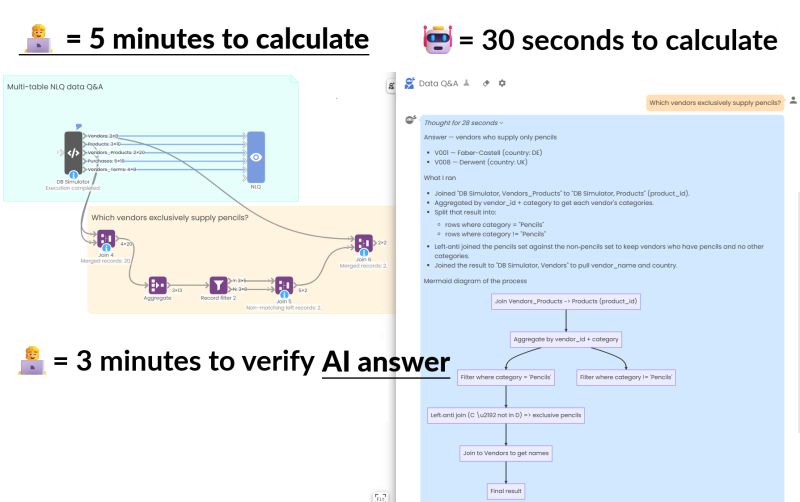
The same question, five tables, one human and one AI.
The human analysis took five minutes. The AI built its answer in thirty seconds, which looked spectacular until I added the three and a half minutes needed to inspect its transformations and verify the result. It was still faster, and the review time was part of the comparison rather than an inconvenient footnote.
The verification layer
What I expect to inspect before accepting the answer.
See the operations.
Filters, joins, calculations and transformations are represented in the platform instead of being hidden inside a conversational response.
Repeat the analysis.
The work can run again against refreshed data, be compared with a human method and become part of a controlled workflow.
Keep a human in control.
People can examine assumptions, revise logic, apply permissions and decide whether the result is safe to use.
We have tested the same tools with private, self-hosted models
Omniscope can work with frontier model providers or self-hosted models. We have tested local Qwen models through vLLM on controlled infrastructure, allowing the model to inspect datasets, plan multi-step analysis and call tools without moving the data into a public AI service.
The setup is known to work, but model fit, endpoint security, GPU cost and version pinning still matter. The generated analytical work remains in Omniscope in a form the user can check.
Read the local Qwen and H100 test ↗
Read about the European AI and analytics stack ↗
Model choice should remain reversible
Models change quickly. We use several frontier and local models, and our own tests regularly show that one is excellent for a particular tool-calling task and disappointing on another. The durable analytical work therefore stays in the projects, workflows, repositories and tests the team controls, rather than becoming inseparable from whichever provider is strongest this month.
We take the same approach to AI-assisted software engineering. The productivity gain is real—I see it every week—but the team still owns the architecture, review and production consequences.