AI analytics · Verification
What Is Verifiable AI Analytics?
A useful AI answer should leave behind the data, operations and assumptions a person needs to check it.
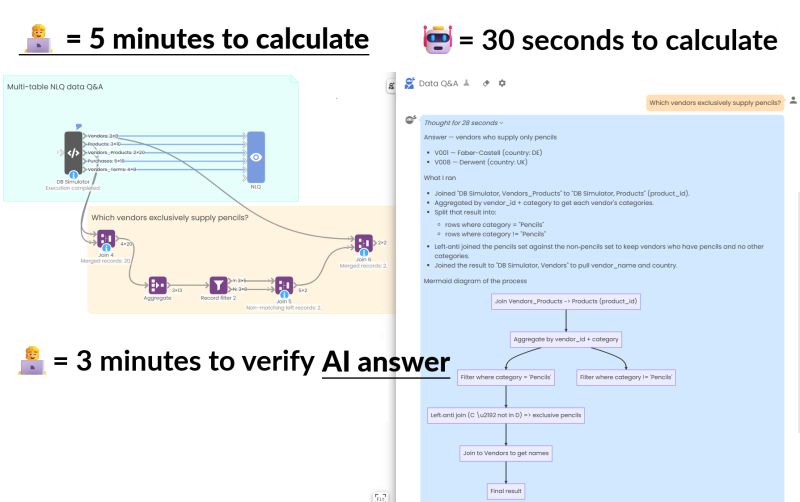
In October 2025 I ran a small experiment in Omniscope. I gave a person and an AI the same apparently simple question:
Which vendors exclusively supply pencils?
The data was spread across five normalised tables. To answer correctly, both had to find the relationships, join at the right grain, identify the pencil products and make sure “exclusively” had not quietly become “also”.
The human analysis took about five minutes. The AI produced a result in roughly 30 seconds. I expected the AI to be faster. What I wanted to measure was the whole task, so the experiment carried on: checking the joins, transformations and conclusion took another three and a half minutes. The original comparison includes both times.
That is what I mean by verifiable AI analytics:
AI-assisted analysis in which the data, definitions, operations, assumptions and resulting evidence remain visible enough for a person to inspect, rerun and challenge.
It does not promise that the answer is true. It gives you something better than a confident sentence: the route to the answer, in a form you can examine.
What the answer needs to show
Language models are very good at producing coherent explanations. That is useful, but in analytics it can also disguise a weak method. A polished percentage may have been built with the wrong date field, a many-to-many join, a calculation at the wrong grain or a filter applied in the wrong place. Missing rows can become zeros. An assumption can appear as if it came from the data.
The pencil question is a good example. A fluent explanation of which vendors “only” sell pencils tells me nothing about whether the query also included vendors selling pens. I need to see the product filter, the joins and the records behind the final set.
Asking the model to explain its reasoning does not fix this on its own. That is more generated language. The executed query, source fields, calculation and intermediate data are what I can actually check.
This distinction sits at the centre of our work on Omniscope as a verification layer.
Who does what
The experiment becomes easier to understand if you separate what the model did, what Omniscope did and what the person checking the result did.
The model interprets and plans
The model interpreted the question, inspected the available schema and planned the filters, joins and calculations it needed. This is exactly the sort of work LLMs are good at: moving from human language to a possible analytical method. It is also probabilistic. Another run or model may choose a different method, and “possible” is not the same as correct.
The platform executes
Omniscope performed the real work against the data: typed filters, joins with declared keys, groupings, calculated fields and the resulting view. Those operations existed as query or workflow steps, not only as prose inside the model response. I could open them and see what had actually run.
A person verifies
The reviewer did not have to rebuild the analysis from scratch. They did need to check which records were included, whether the joins multiplied rows and whether the result matched the meaning of the question.
The test I use is simple: could I explain and defend this method to somebody else? If not, the answer is not ready just because it looks reasonable.
What I want to inspect
Verification needs more than a source link or a paragraph about the model’s reasoning. It needs the pieces a reviewer would actually use.
The analytical lineage
I want to see the path from the five source tables to the final vendor list: which data was selected, how the tables were connected, where fields were derived and in what order the operations ran. The same principle applies to a much larger workflow.
Metric definitions
“Exclusively” was the dangerous word in the pencil test. In another analysis it might be “revenue”, “active customer” or “conversion”. These terms are not self-defining. The workflow needs the relevant definition, including time windows, denominators, exclusions or currency treatment, rather than letting the model quietly choose one.
Calculations and input values
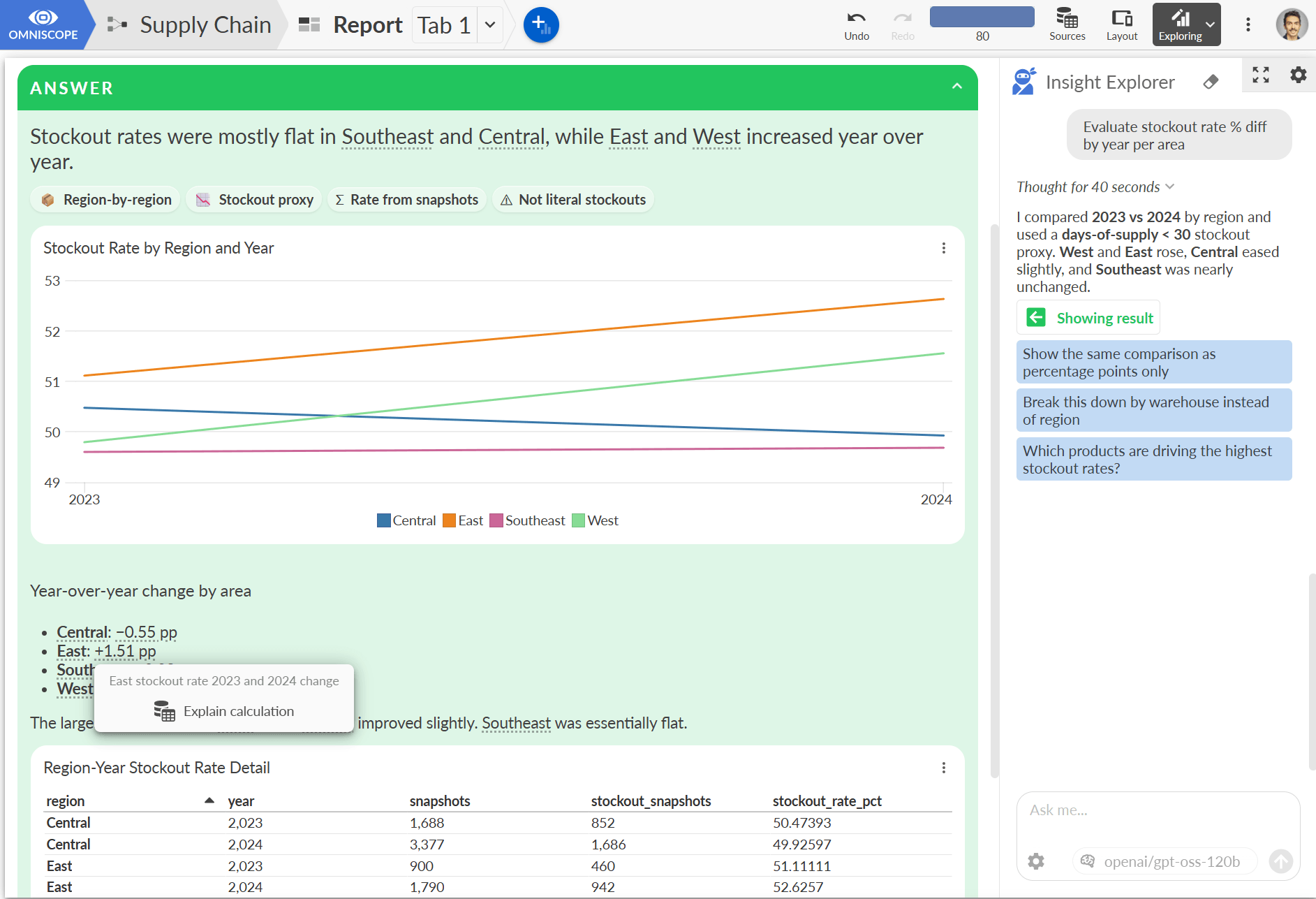
If an answer says growth was 17.4%, I should be able to open that number and see the two values, formula and time periods behind it. This sounds obvious, but an early tester caught us presenting calculations in prose without enough visible provenance. The objection was right, and we changed the product.
Assumptions and limitations
Some questions need an assumption because the required information is not in the data. Fine, but say so. A reviewer should be able to distinguish a source value from a calculation, a user-supplied parameter and an assumption the model introduced. Unresolved limitations should remain visible too.
The produced artefact
In Omniscope Insight Explorer, the answer can leave behind query lineage, selected data, formulae, input origins and the chart configuration. I can open that work, edit it, rerun it and, if it is worth keeping, add the query or chart to a report. It does not have to disappear with the conversation. The Insight Explorer documentation describes that answer-to-artefact path in detail.
Reproduction and analytical judgement
A visible workflow can reproduce the same wrong join very efficiently. It can also expose a perfectly repeatable calculation based on a poor definition or incomplete data. I still need to know what ran, against which data and with which settings, but then somebody has to judge whether that method was appropriate for the question.
The answer may also legitimately change. New rows can arrive. A metric definition can be revised. A source system can restate history. A software version can alter an algorithm. Reproducibility only has meaning when those inputs and versions are identified.
A practical verification test
For analysis that will affect a real decision, these are the checks I care about:
- Can I identify the source data, its refresh time and the permissions used?
- Can I see how the business terms were defined?
- Can I inspect the filters, joins, groupings and calculations that ran?
- Are assumptions and limitations separate from findings derived from data?
- Can another person rerun the work and compare it with a known case or independent method?
- Is somebody still responsible for deciding that the result is fit to use?
Version history and a saved report or workflow help because they preserve what changed and give useful work somewhere to live. If the only supporting evidence is confident prose, I would not use the answer in a consequential process.
As model quality improves
Better models are producing better plans and fewer obvious errors. Great. They are also making an unchecked result easier to accept because it looks so finished.
In the pencil experiment, 30 seconds for the first answer plus three and a half minutes of inspection was a good result. The mechanical work became much faster, and the person could spend the remaining time on the meaning of the question and the joins that supported it. That is the trade I want. A 30-second answer I cannot inspect would be much less useful.