Public alerts · Provenance
Designing Alerts That Preserve the Evidence Behind the Claim
The social post should attract attention without becoming the only surviving record of the measurement, method and context.
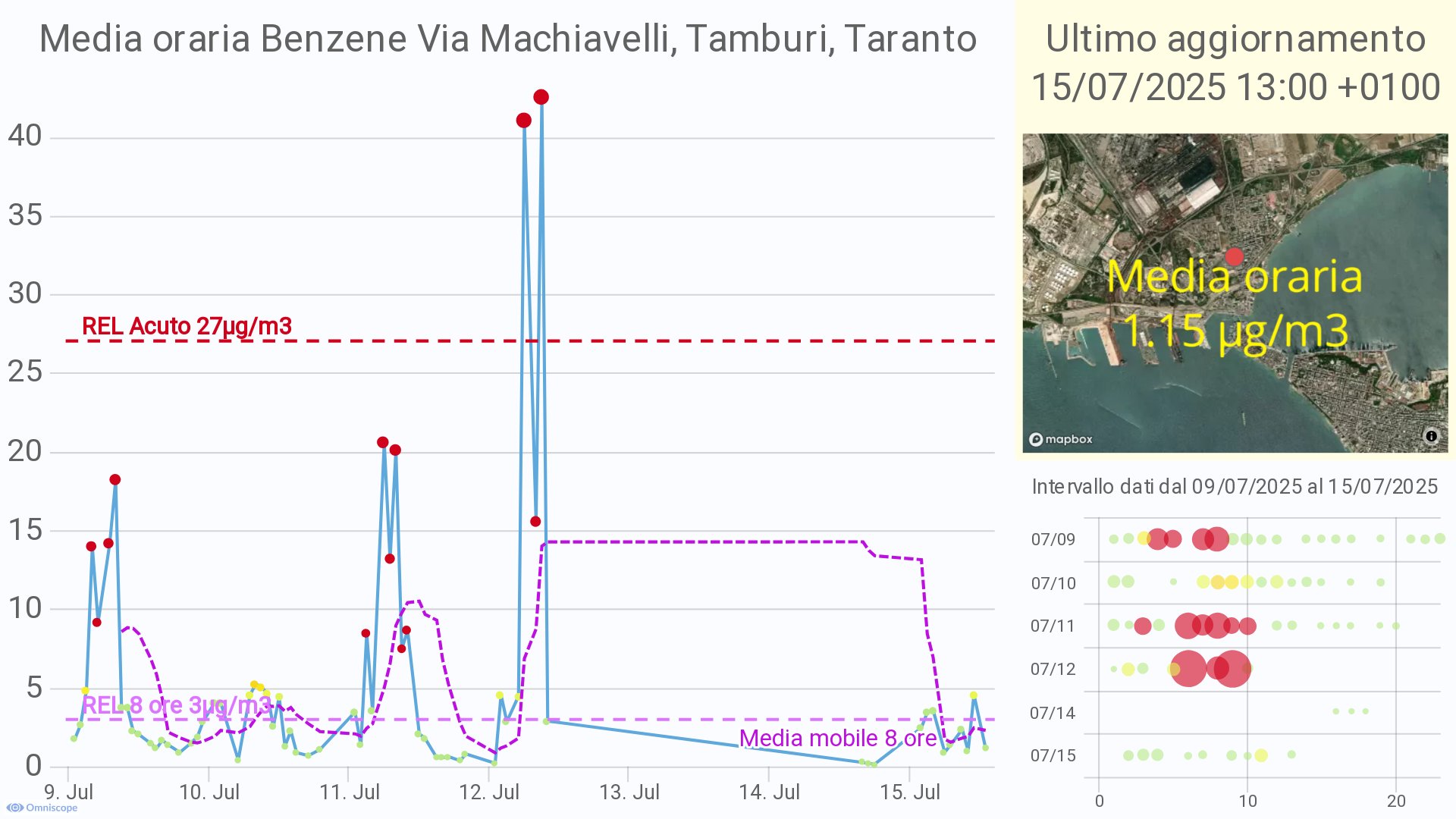
A real Via Machiavelli alert reported an hourly benzene value of 42.54 µg/m³ against the 27 µg/m³ acute reference. Strip away the station, hour, unit and reference, and it becomes:
High benzene in Taranto: 42.54.
Which station? Which hour? Which unit? Was 42.54 an hourly mean or an instantaneous value? High compared with what? Was the source provisional? What happened before and after? Can anybody inspect the observation?
The number gets attention because it is large. The missing context makes it difficult to assess and easy to misuse.
I built the Taranto automation so a reader could move from that number to the station, surrounding hours, threshold definition and source data in the Omniscope report.
The alert is the last step of a data workflow
The visible post may contain one sentence and one image. Behind it sits a complete process:
official source
  → retrieve and timestamp
  → type and validate
  → preserve station and averaging grain
  → apply an explicit reference rule
  → isolate new qualifying observations
  → generate evidence image and text
  → publish
  → link to the interactive report
  → record what was sent
In the original OmniscopeBot implementation, an Omniscope workflow obtained the data, transformed it, compared measurements with configured conditions, generated a report screenshot and passed qualifying rows to a Python block for publication.
The code that called the social API was a small part of my work. Most of it was in the preceding workflow: preparing the source data, preserving its hourly meaning, applying the configured condition and deciding what the screenshot and text had to contain.
What I include in each alert
For each measurement-based alert I keep enough information to interpret the number and a direct route to the fuller report.
1. Station and pollutant
“Taranto” is not a measurement location.
Name the station and pollutant. If the station identifier changed, preserve the identifier used by the source.
2. Observation time and timezone
State the hour or period represented by the value, not only when the post was published.
Use a timezone. Environmental series cross daylight-saving changes, and “03:00” can otherwise become ambiguous.
3. Value, unit and averaging duration
Write:
42.54 µg/m³, hourly mean
not:
42.54
The averaging duration is part of the measure. Hourly, daily and annual values cannot be compared as if they were the same threshold event.
4. Reference and its status
If the alert uses 27 µg/m³, call it the OEHHA acute Reference Exposure Level for infrequent one-hour benzene exposure and non-cancer effects.
Also say what it is not: exceeding the reference is neither proof of individual harm nor an Italian or EU ambient legal breach.
A threshold without its authority, duration and legal status invites a much stronger interpretation than the data supports.
5. Source-data status
Identify the agency and whether the observation is provisional or validated where that information is available.
If a later validated file can revise the value, the publication process needs a way to retain or amend the original alert.
6. Evidence link
The post should link to a report where a reader can inspect the surrounding hours, longer history, station comparisons, source rows, update time and gaps in coverage.
The current Aria Taranto report and benzene history provide that path.
7. Workflow and publication time
The observation may represent 03:00, the source may publish it later, the workflow may retrieve it at 05:10 and the social API may accept the post at 05:11.
I preserve each time separately because they describe different stages of the same alert.
The screenshot is a bridge
A useful screenshot shows the current observation, reference line, preceding hours or days, station name, source update time and units. That is enough for a reader to decide whether to open the report.
It may be compressed by the platform. Alt text may disappear. The post may be re-shared without its link. A screenshot also freezes the provisional state at publication time while the report may later refresh.
I use the screenshot for the immediate view and the report for the data and history that cannot fit inside it.
Context should counterbalance the peak
An alert feed naturally emphasises exceptional events. Without longer-term context, it can leave the false impression that conditions never improve.
In the incomplete 2025 period available when this comparison was published, Taranto reporting showed a falling number and average of high daily benzene readings across several stations from 2023 into 2025, while individual hourly episodes still deserved attention.
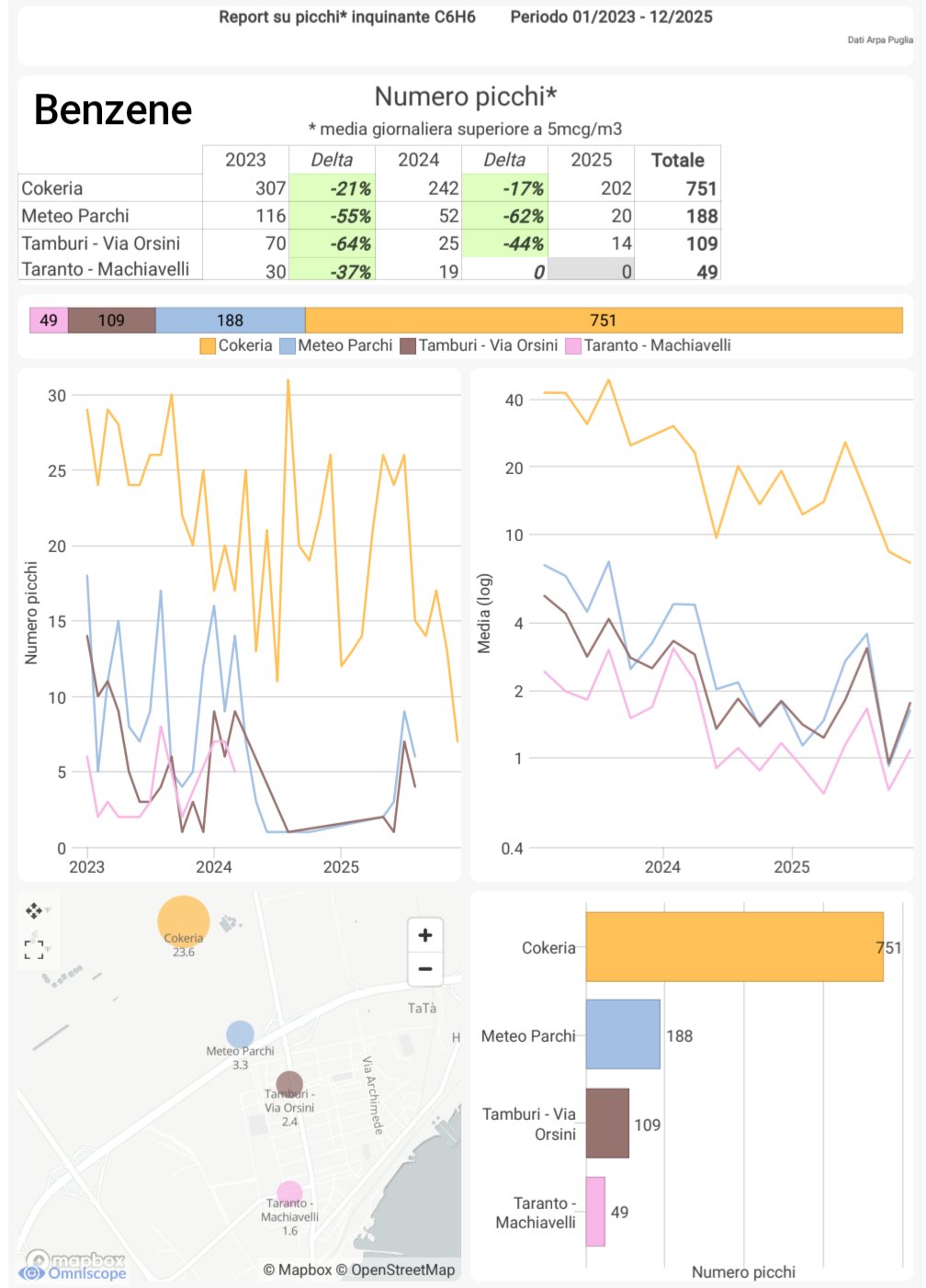
The alert channel and historical report should show both the individual event and the longer direction.
Do not rewrite the historical rules
The first 2023 OmniscopeBot tutorial used a different, lower trigger in its example. The current project uses the 27 µg/m³ acute reference for particular hourly alerts.
It would be inaccurate to describe every historical post as if it used today’s rule.
Store a rule version with each alert:
- threshold value;
- comparison operator;
- averaging period;
- pollutant and station scope;
- source of the reference;
- effective date;
- workflow version.
When the rule changes, history should explain the change rather than silently reclassifying old publications.
Handle duplicates and revisions
Once I automated publication, timeouts, retries and source revisions became part of the same workflow.
Duplicate protection
A retry after a timeout may publish the same observation twice.
Use a stable key such as:
source + station + pollutant + observation_timestamp + rule_version
Record successful publication separately from attempted publication. Do not assume an HTTP timeout means the social platform rejected the post.
Source revisions
If provisional data is corrected, retain:
- the value originally alerted;
- the corrected value;
- revision time;
- source file or record version;
- whether the alert was amended or withdrawn.
Deleting the old post without explanation weakens the public record.
Gaps
If the source or workflow is unavailable, the gap needs to remain visible. Silence from the alert account cannot establish that there were no high readings.
Keep a record outside the social platform
The Taranto alert channel began on X through OmniscopeBot and later moved to the Aria Taranto Facebook page.
Platforms change API access, link behaviour, image quality and account policy. Accounts can be suspended or removed.
I therefore keep the durable record under project control:
- alert payload;
- source observation or snapshot;
- generated image;
- rule version;
- workflow execution;
- publication result and platform identifier;
- canonical report URL;
- correction history.
The social platform distributes the alert, while this retained material allows the project to reconstruct or correct it later.
Learn from official communication standards
Annex XVI of Directive 2008/50/EC requires official exceedance information to identify matters such as location, threshold type, start and duration, and concentrations.
Citizen benzene alerts are not statutory EU alerts, and this does not make them so.
The structure is still useful design inspiration. Public warnings should tell people what happened, where, when, at what concentration and against which defined reference.
I apply the same practical test to each alert: it should explain the measurement when published and leave enough state for me to trace and correct it later.