Open hardware · Data ownership
Open Hardware, Private Infrastructure and Citizen-Owned Monitoring
Buying an open monitor gave me control over the hardware, firmware, network path, stored history and analysis—and responsibility for all of them.
An air-quality monitor can be described as open because its schematic is published. That gives an owner something real to inspect, repair and adapt, but it does not tell you who controls the firmware, where the measurements travel, whether the vendor cloud can be disabled, who holds the historical record or whether a citizen can reproduce the analysis behind a public claim.
My recent AirGradient experiment began as a way to understand the air in my room. It became a useful test of how far citizen ownership can extend: from an open physical device, through local configuration and custom firmware, into a private analytics workflow and an inspectable report.
The complete AirGradient-to-analytics build covers the installation. Here I am looking at what I could actually control, change, retain and recover after buying an open monitor.
Layer 1: the physical instrument
AirGradient publishes code, schematics and 3D files under CC BY-SA 4.0 and states that monitor owners own their data. Its open-files overview covers the hardware materials, design and enclosure files.
I can inspect the design, repair the monitor, make replacement parts, modify the firmware, use it for education and adapt it to another data path.
Open hardware does not guarantee measurement quality. Sensor selection, airflow, enclosure design and maintenance still matter. It makes those choices more inspectable.
Layer 2: firmware
The firmware decides what the physical instrument actually does: reading the sensors, calculating or exposing indices, connecting to Wi-Fi, posting to a vendor service, answering local API requests, retaining credentials, installing updates and sending measurements elsewhere.
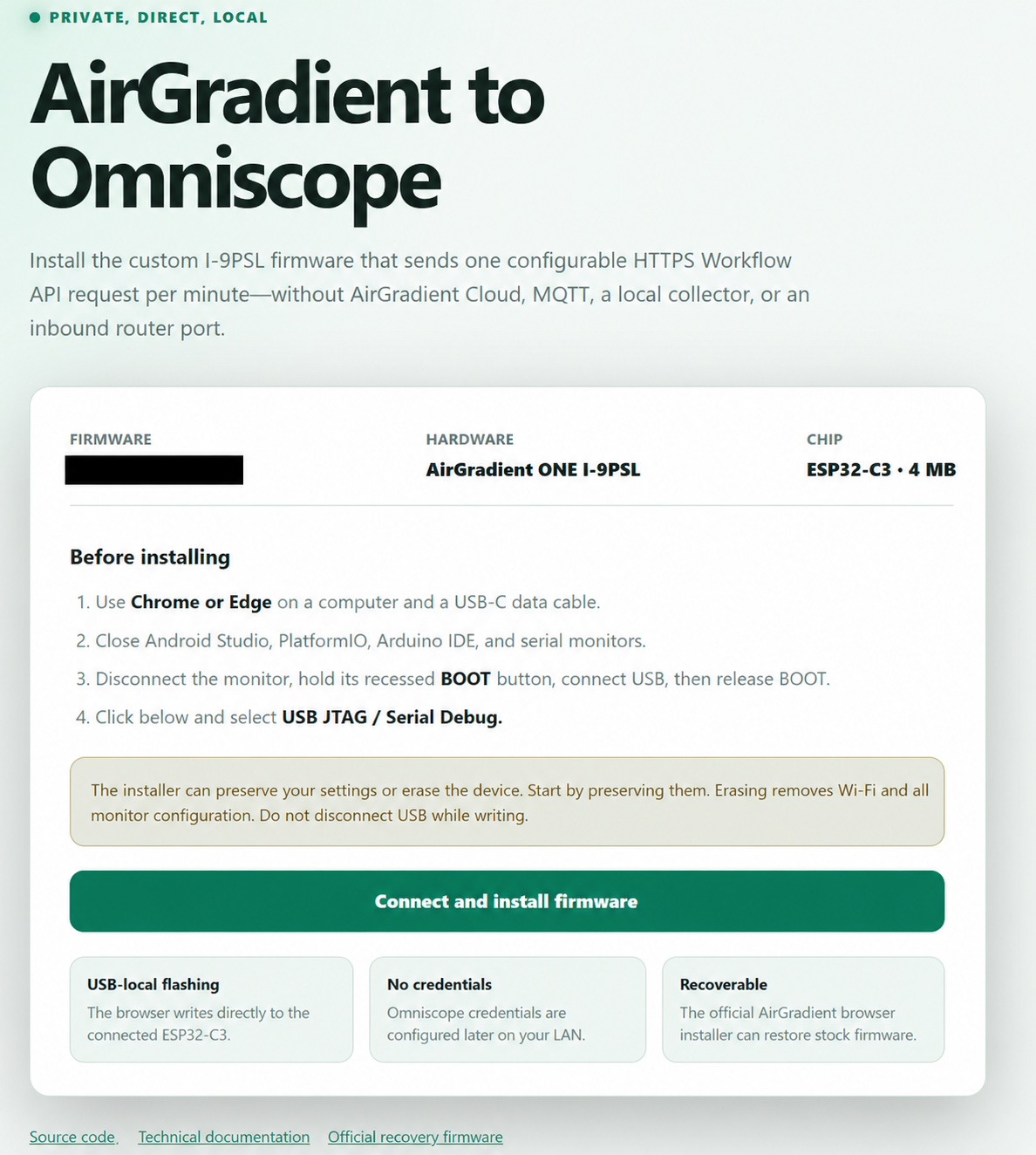
For my experiment, I forked the official AirGradient firmware at version 3.3.9 and published the airgradient-omniscope source.
The fork adds a configurable, authenticated HTTPS request to an Omniscope workflow every minute. The release retains upstream attribution and documents the exact base.
This version pin is part of reproducibility. “Based on the open firmware” would not be enough to reconstruct the device later.
Layer 3: local control
A citizen should not need the vendor cloud to see current measurements or change local configuration.
The AirGradient firmware exposes a local API from which a device on the same network can retrieve current measurements, configuration and metrics.
I built a small
Android controller
around that API. It connects only to .local, loopback, link-local or private
LAN addresses and accepts only the required read and configuration operations.
It has no account, advertising, analytics SDK or cloud runtime.
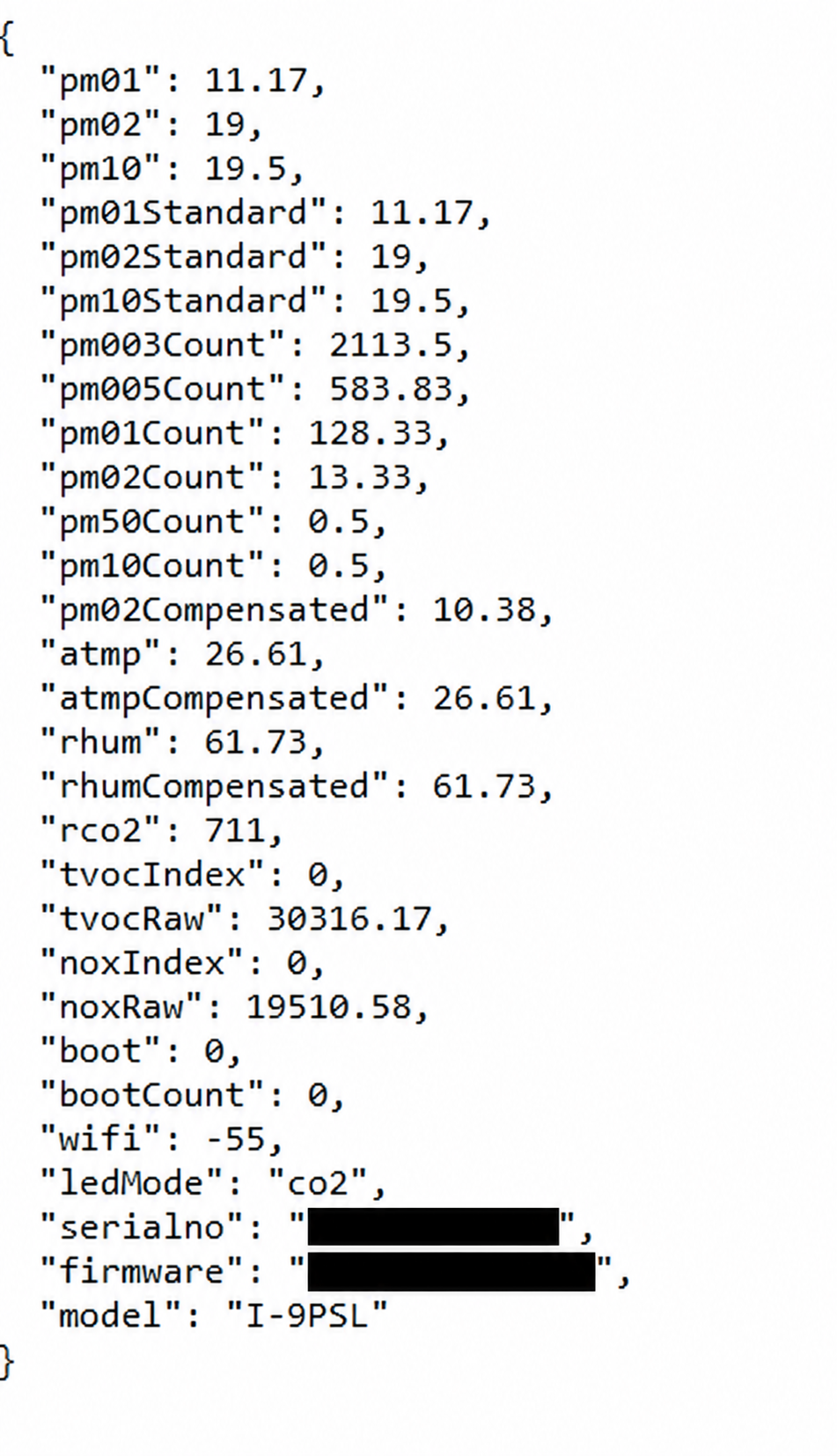
The phone is a control surface, not a background collector. If the phone is off, the historical data path continues.
Layer 4: transport
Owning the device while every measurement travels through an unwanted vendor service is incomplete ownership.
In my configuration:
AirGradient cloud posting: disabled
vendor cloud connection: disabled
network task: enabled
Omniscope workflow push: enabled
The monitor makes one outbound HTTPS request to a configured Omniscope endpoint. I do not run an inbound router port, Raspberry Pi poller, MQTT broker, separate receiver service or phone-based collector.
This does not make direct HTTPS universally better. A broker and local gateway are appropriate for many fleets. Here, removing them made the path easier to understand and operate.
The transport still needs security: TLS validation, dedicated credentials, least privilege, endpoint restrictions and a plan for credential rotation if the device is lost.
Layer 5: stored history
A vendor application may show the current value while retaining the historical record under its own account and export rules. I wanted to know where my measurements were stored, in what format and who could export them. The history also needed to survive a provider change while preserving timestamps, units, missing periods and the raw payload.
The receiving Omniscope workflow parses the device JSON, adds a server-side UTC receipt time and appends the observation to storage controlled by the deployment.
I deliberately did not add a flash-backed queue to the monitor. If submission fails, that minute becomes a gap. The design avoids replay and flash-wear complexity at the cost of incomplete delivery.
That trade-off leaves visible gaps, and I know they came from failed delivery rather than a hidden edit to the history.
Layer 6: analysis
I also wanted analytical access to the history. The source observations can be inspected, new measures derived, periods compared and the report changed. The result can be exported or moved to another tool, with the method behind a public conclusion retained alongside it.
In the current project, the workflow and report remain visible. PM, CO₂, VOC and NOx indices, temperature, humidity, Wi-Fi state and metadata can be examined across time.
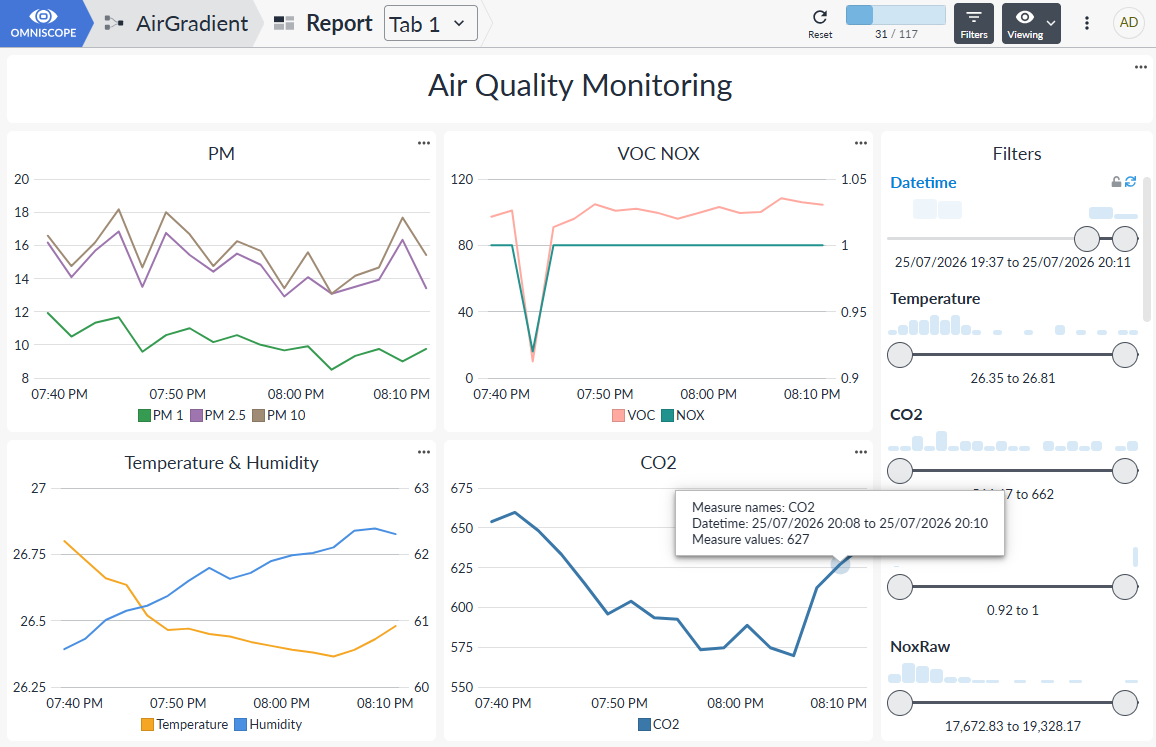
The analytical layer is part of ownership: the complete path from incoming measurement to interactive history can be inspected and changed.
Layer 7: publishing and keeping the record
Citizen-owned monitoring may remain private, or it may contribute to a public record.
If I publish a result, I retain its source snapshot, transformation and rule version, chart and report, alert payload, correction history and a canonical URL independent of the social platform.
A social post can distribute a finding. It should not be the only copy of the evidence.
This is a lesson from the longer Taranto project, where the public alert channel moved from X to Facebook while the Omniscope reports remained the analytical record.
Open installation should include recovery
Publishing the source fork was only part of making the physical device reproducible.
The firmware project includes:
- build instructions;
- versioned release binaries;
- SHA-256 checksums;
- a browser-based USB installer;
- a route back to stock firmware.
Custom firmware can fail. My first HTTPS build caused a networking-task stack overflow and rebooted the device. The fix increased the task stack from 4096 to 12288 bytes.
A responsible open project should help somebody return to a known state, not only encourage the interesting modification.
The sensor’s limits travel with the data
The AirGradient ONE is a low-cost personal monitor, not an ARPA regulatory station.
Its Sensirion SGP41 VOC and NOx outputs are primarily indices of relative change rather than direct absolute concentrations of one named pollutant. Everyday products such as alcohol-based cleaners, ethanol and sunscreen can affect VOC readings. Placement, airflow, warm-up, ageing and environmental conditions matter.
I can use the monitor for ventilation experiments, observing indoor patterns, careful comparisons between rooms or periods, identifying events worth investigating, education and testing the rest of this citizen infrastructure.
It does not justify presenting an index as a regulatory pollutant concentration.
Open access makes it easier to examine the limitation. It does not remove it.
Citizen instruments and regulatory stations have different roles
Regulatory networks provide calibrated, governed measurements with defined siting, maintenance and validation.
Citizen sensors can add denser local observation, rapid experiments, indoor context, community participation, hypotheses for further investigation and independent technical learning. I see that role as complementary to the regulatory network.
A citizen network can make a pattern visible and ask a precise question. An official station or validated study may be required to support a stronger claim. Stating that boundary increases credibility.
Ownership creates responsibility
Running the full stack means accepting work the vendor previously carried. I have to protect credentials, maintain firmware, monitor delivery, back up the history and document changes. I also have to calibrate or compare sensors where appropriate, disclose their limitations, correct public claims and plan for what happens when the original operator leaves.
A citizen-owned monitoring checklist
I would call a monitoring path citizen-owned when its operator can answer:
- Can I inspect and repair the physical device?
- Can I inspect, build and replace the firmware?
- Can I access current measurements locally?
- Can I disable unwanted cloud posting?
- Do I control the destination and credentials?
- Do I understand the network path?
- Can I export and preserve the raw history?
- Can I inspect the transformations and report?
- Can I recover stock or known-good software?
- Are sensor limitations carried into every claim?
- Can the evidence survive a social-platform change?
- Is somebody responsible for security, maintenance and correction?
An open-source badge on its own cannot answer all twelve.
What changed when I controlled the whole path
Open hardware made this experiment possible. I could choose the data path, turn the stream into history in a visible Omniscope workflow and document the result so somebody else can inspect or adapt it.
The AirGradient remains a small personal sensor, with the limitations described above. What I gained was control over how I observe the room, preserve the measurements and analyse them, together with responsibility for explaining honestly what the monitor can and cannot support.