No-code · Custom software
Where No-Code Ends and Custom Software Should Begin
How I decide whether a requirement belongs in a visual workflow, a bounded Python/R/JavaScript component or a separate service.
In 2022 I described Omniscope as a no-code development platform. It began with questions people actually ask after hearing “no-code”: how do I load the data, clean it, analyse it, build the interface, automate the result and deploy it? Near the end I invited developers to extend the same workflows with Python and R, or build custom interfaces with HTML and JavaScript.
Both parts were intentional. A common join is usually clearer in a visible workflow. A specialised forecasting library may be clearer in Python. A transactional customer record may belong in a database behind an application service, while a distinctive browser interaction may require JavaScript. In practice I choose from those options by following the job and its operational requirements.
What visual tooling is good at
Visual workflow blocks work well for the operations that appear in almost every data project: importing files, databases and APIs; selecting, renaming and typing fields; filtering, sorting, joining, appending, aggregating and pivoting; calculating known formulae; and validating records. The same workflow can accept parameters, run on a schedule, be monitored and feed reports or exports.
A domain expert can inspect that sequence, a reviewer can open an intermediate result and an error can point to a particular block. A later builder can change one filter without first reverse-engineering an undocumented script.
A complex visual workflow can express substantial logic. I keep using that representation while it continues to help people understand and change the work.
The first boundary: specialist method
Embedded Python or R becomes useful when the project needs a particular statistical or machine-learning library, a domain-specific algorithm, a custom optimisation, an unusual file or protocol, or a well-tested internal package. It can also be the sensible choice when a sequence of generic operations cannot provide the required performance.
I want that code to own the specialist part while the surrounding selection, validation, comparison, reporting and scheduling remain visible.
For example:
visual workflow
  → select and validate modelling fields
  → custom Python block runs specialist algorithm
  → typed result returns to workflow
  → compare, report and schedule visibly
The workflow still shows where the method is used, what enters it and what comes out. This is the same idea behind the Python and R Custom Blocks we added to Omniscope: the script can use its specialised runtime without taking the whole data path with it.
The second boundary: specialised interaction
A report can cover a great deal with charts, filters, tables, parameters and editable fields. Custom HTML and JavaScript become appropriate when the user needs a guided multi-step form, a domain-specific canvas or diagram, drag-and-drop planning, a bespoke control surface, integration with another browser component or a highly branded embedded experience.
The custom view should still consume defined data and parameters and emit defined events. In the customer-success prototype, JavaScript extended a focused part of the application while the workflow, validation and reporting remained in Omniscope. Letting the view grow into a second unversioned application framework would have lost that advantage.
The third boundary: a separate system
Some requirements belong outside the analytical platform. High-concurrency transactional writes or strict consistency across several entities usually need a separately engineered service or system of record. The same may be true for complex authentication or delegated authorisation, independent scaling and availability, a public API with a long-lived external contract, low-latency event processing, offline mobile behaviour, specialised security certification or an application lifecycle owned by another team.
The analytics workflow can still participate. It may prepare data, calculate scores, expose a governed result or drive the reporting surface. It should not pretend to own responsibilities for which it was not designed.
The customer-success prototype described in the previous article used SQLite for transactional records and Omniscope for the visible preparation, validation, editing and reporting. That boundary was more honest than treating an editable analytical table as the whole database.
A decision matrix
When deciding where a component belongs, I use questions like these:
| Question | Visual workflow | Embedded code | Separate software |
|---|---|---|---|
| Is the operation common and well understood? | Usually | Sometimes | Rarely |
| Must business reviewers inspect it directly? | Strong fit | Expose inputs/outputs | Provide separate evidence |
| Does it depend on a specialist library? | If a native block exists | Strong fit | If it needs its own runtime/service |
| Is the behaviour highly transactional? | Weak fit | Weak fit | Strong fit |
| Does it need independent scaling? | Limited | Limited | Strong fit |
| Does the user need a bespoke interface? | Standard interactions | Custom view | Full application |
| Will it change frequently with business rules? | Strong fit | If tests and ownership exist | If a product team owns it |
| Must it deploy independently? | No | Usually no | Yes |
I do not calculate a score from this table. I use it to make the reason for crossing the boundary explicit before we add another runtime or service.
Contain custom code
Custom code creates capability and responsibility. The checklist I use is deliberately practical.
A Python block should have:
- explicit input and output schemas;
- pinned or managed dependencies;
- bounded memory and execution time;
- only the files and network routes it needs;
- tests against known cases;
- logging that avoids secrets;
- a version and owner;
- a documented failure contract.
Omniscope can execute custom Python and R blocks in isolated Docker containers. The container-execution documentation describes explicit images, volumes and server policy.
Isolation limits what a failed or hostile script can reach. Correctness, dependency safety and analytical suitability still need their own tests and review.
Package repeated exceptions
The first custom script may be a justified exception. By the fifth copy, the same method probably deserves a reusable custom block, shared library, versioned service, template, macro or governed API. Give it a clear name and interface, test the component boundary on every change, publish a versioned artefact and reuse that known version.
That is how a useful exception becomes part of the team’s normal toolbox instead of another pasted fragment.
AI-generated code is still custom software
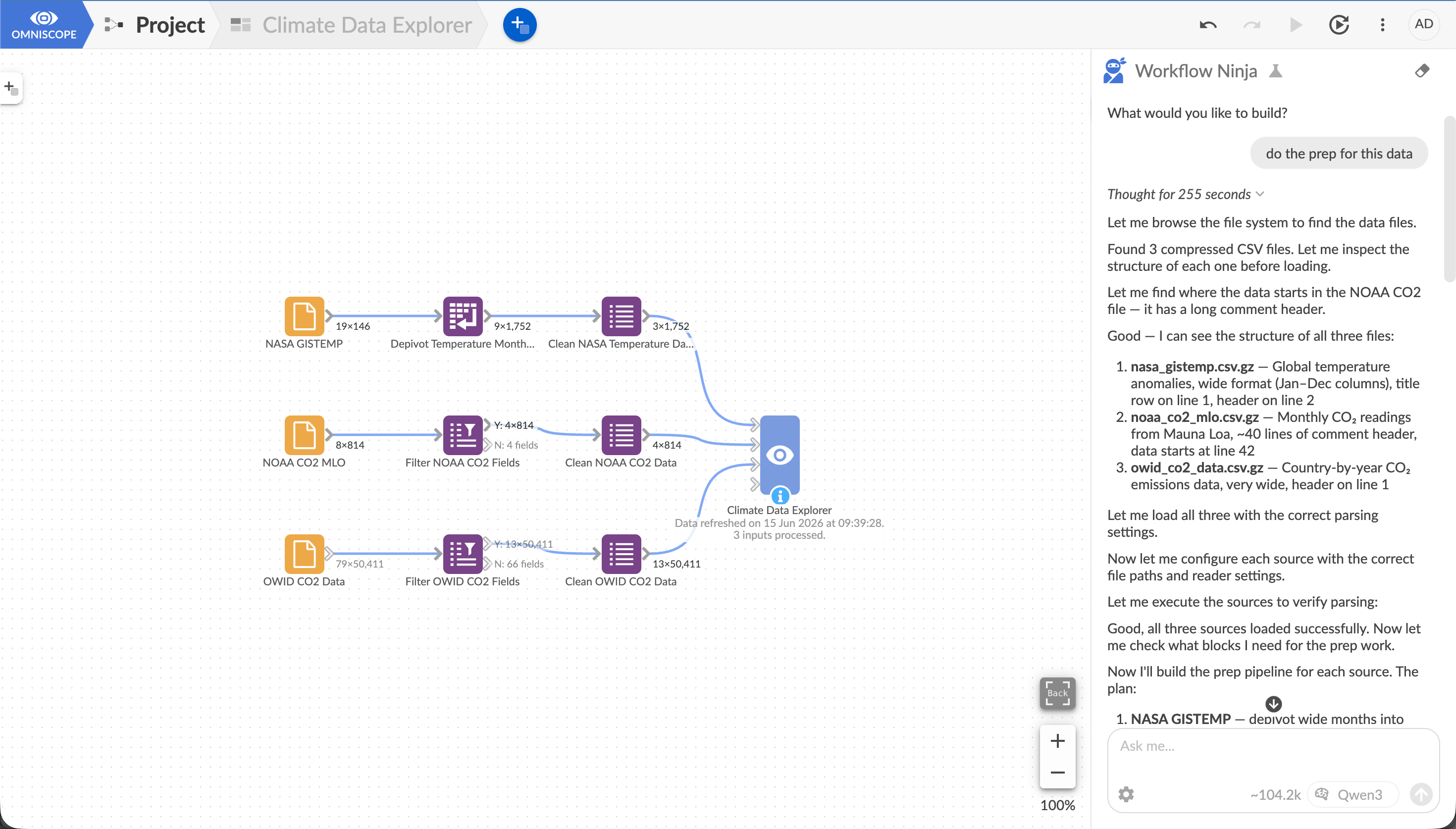
AI reduces the cost of generation, while dependency, security, testing, review and ownership remain part of the software. In the Data Quality Inspector experiment, asking an agent for the whole stack at once lost the plot; the useful middle ground was to let AI create bounded pieces while I controlled architecture, assembly, review and deployment.
Signs you have stayed no-code too long
I become suspicious when dozens of blocks imitate one clear algorithm, performance depends on repeated workarounds or the workflow hides the method instead of explaining it. A specialist library may already solve the problem well. Error handling may be impossible to express safely, the interface may be fighting the user’s job, or files may be simulating transactional behaviour. If the same workaround has been copied across projects, the boundary has probably been postponed for too long.
At that point, adding a contained block or service can remove complexity from the shared workflow.
Signs you introduced custom software too early
I stay visual when the logic is common and already provided, or when business users need to review and change it. A script that mostly moves and renames fields is rarely earning its own runtime. A bespoke service may add deployment and monitoring work without adding capability, and code understood only by its original author is a warning—especially when the team has no plan to test or own it.
Writing 200 lines of code for a join still leaves us with a join.
No code does not mean no engineering
A visual data application still needs sound modelling, validation, access control, tests, release management, monitoring, retention and an owner. Custom code arrives with exactly the same obligations.
The Data Quality Inspector kept its preparation, API wiring, template, deployment and report in Omniscope while a bounded Python block added a useful method. The customer-success prototype went one step further: SQLite owned the transactional records, Omniscope owned the visible analytical application, and Python and JavaScript extended selected parts.
Those were practical boundaries discovered while building. I could still open the workflow and understand the complete application, while each specialised component carried the responsibility it was designed for. That is the result I look for when deciding where the next piece should live.